

What to Pack for Rome in August (2026): Outfit tips for hot 88°F days against ochre-plaster & travertine-stone backdrops
August · 20–31°C (68–88°F) · Sun gear, basilica-covering layers, and shoes that can handle Rome's hot basalt paving
Start Here
Table of Contents
Setting the Scene
What to Expect in Rome in August
You notice the light first in Rome in August: a white, reflected glare bouncing off travertine, church facades, bus roofs, and the broad stones around the Colosseum until the whole city seems to hum with heat. Then come the smells: espresso from bars already pulling shots at 7am, warm pine from umbrella pines on the Palatine side, and the mineral scent that rises from fountains where people pause to refill bottles. Outside Termini you hear suitcase wheels rattling over broken paving, mopeds slipping between buses, and the metallic hiss of the doors on an orange ATAC bus opening into a blast of hot air. By mid-morning, Romans who are still in town move fast and deliberately: linen shirts, floaty cotton dresses, open sandals, and sunglasses worn not as an accessory but as armor. In Prati and around Via Cola di Rienzo, locals do errands early, then disappear indoors during the worst heat. Around the Pantheon, visitors slow down under the sun while delivery riders and bar staff keep moving with the practiced rhythm of people who know exactly where the next patch of shade falls. August is peak tourist month for landmarks, yet it can feel oddly hollow in residential stretches because Ferragosto empties the city of many Romans. You get long queues at the Vatican Museums, but shuttered neighborhood shops near Testaccio, handwritten signs saying chiuso per ferie, and a sense that the city is operating on summer half-speed.
After sunset, Rome changes register rather than cooling down. The stone still radiates heat, but the city loosens. Along the Tiber, near Isola Tiberina and the riverbank walks used for summer events, you smell fried food, river damp, sunscreen that never quite washed off, and the sweet edge of melone sold from chilled displays. At Piazza Navona, buskers compete with the splash of Bernini's fountains; in Trastevere, glasses clink under ivy and you hear snippets of Roman dialect rising from outdoor tables. The sound that stays with you is not one grand landmark noise but the layered soundtrack of late summer Rome: scooters on lungotevere roads, church bells landing heavily in thick evening air, and the soft grind of chairs being dragged across stone before dinner service. People dress with more polish than the heat would suggest. Roman women often pair airy trousers or midi dresses with good sandals and a structured bag, while men wear tailored shorts or light chinos rather than beachwear. Even on the hottest days, you do not see locals entering churches in swimwear or shirtless post-sightseeing outfits. That matters because a day in Rome easily runs from the Forum to a basilica, from a museum to dinner in Monti, and clothing has to handle all of it. August also has a peculiar split personality: around Trevi Fountain and St Peter's the city is still packed, but on Ferragosto week parts of Rome feel almost suspended, with pharmacy shutters down, family-run trattorias closed, and the grandest spaces of the historic center somehow sounding wider and more echoing than usual.
Nasoni Pause
Cold fountain water between blazing walks
Moped Rush
Scooters thread noon traffic and heat
Tiber Evenings
River stalls, music, warm night air
Basilica Cover
Shoulders wrapped before church doors
See Also
Rome weather in August
Average Temperature
August
31°C / 88°F
20°C / 68°F low
Peak heat, mostly dry
3.3 days
Brief storms, then steam off stone
10 hours
Hard glare on travertine and piazzas
64%
Humid enough after late storms
11 kmh / 7 mph
Usually light, weakest of the year
Local Style
What does Rome in August feel like?
🔥
Rome in August feels hotter than the thermometer suggests because the city throws heat back at you from travertine facades, pale piazzas, and black basalt sampietrini. If you come from a drier inland summer climate, the shade around the Pantheon can feel manageable but the walk across the open Forum or Piazza Venezia can suddenly feel oven-like by early afternoon. Evenings stay warm rather than cool, and air-conditioning can feel icy inside museums, department stores, and airport trains. Rain is uncommon, but when a thunderstorm breaks over the city the streets around Campo de' Fiori can turn steamy within minutes.
Style Palette
Colors of Rome
Rome's sun-baked plaster walls and weathered facades that define the historic center.
Wear this to melt into the golden Roman light and look like a local in the afternoon sun.
The warm, earthy base makes tanned or golden undertones look absolutely radiant.
The massive, porous limestone of the Colosseum, the Trevi Fountain, and countless curbsides.
This shade provides a clean, expensive-looking contrast that doesn't compete with the city's vibrance.
It's a sophisticated neutral that won't wash out fair skin like a starker white might.
The deep, ecclesiastical reds found in church tapestries, vintage Vespas, and velvet restaurant curtains.
A bold pop that stands out sharply against the pale stone and dusty streets.
This rich berry-red brings a healthy flush to cool and neutral complexions.
The towering Mediterranean pines and manicured hedges of the Villa Borghese gardens.
This deep green offers a refreshing visual break from the city's intense heat and stone.
It's particularly striking on those with red hair or warm, deep skin tones.
Signature Outfit
A Travertine Bone linen midi dress paired with Trastevere Ochre leather slides. Tie a Pincio Cypress silk scarf around your hair to keep cool while exploring the ruins. The light fabrics breathe in the August heat, while the palette mirrors the shift from ancient stone to shaded garden.
Blend In Like a Local
How to Dress in Rome Without Looking Like a Tourist
Heavy denim and charcoal grey. August in Rome is sweltering, and dark, thick fabrics look physically oppressive and visually out of sync with the city's airy, sun-drenched aesthetic.
Top 3 Outfit Colors to look perfect in every Photo
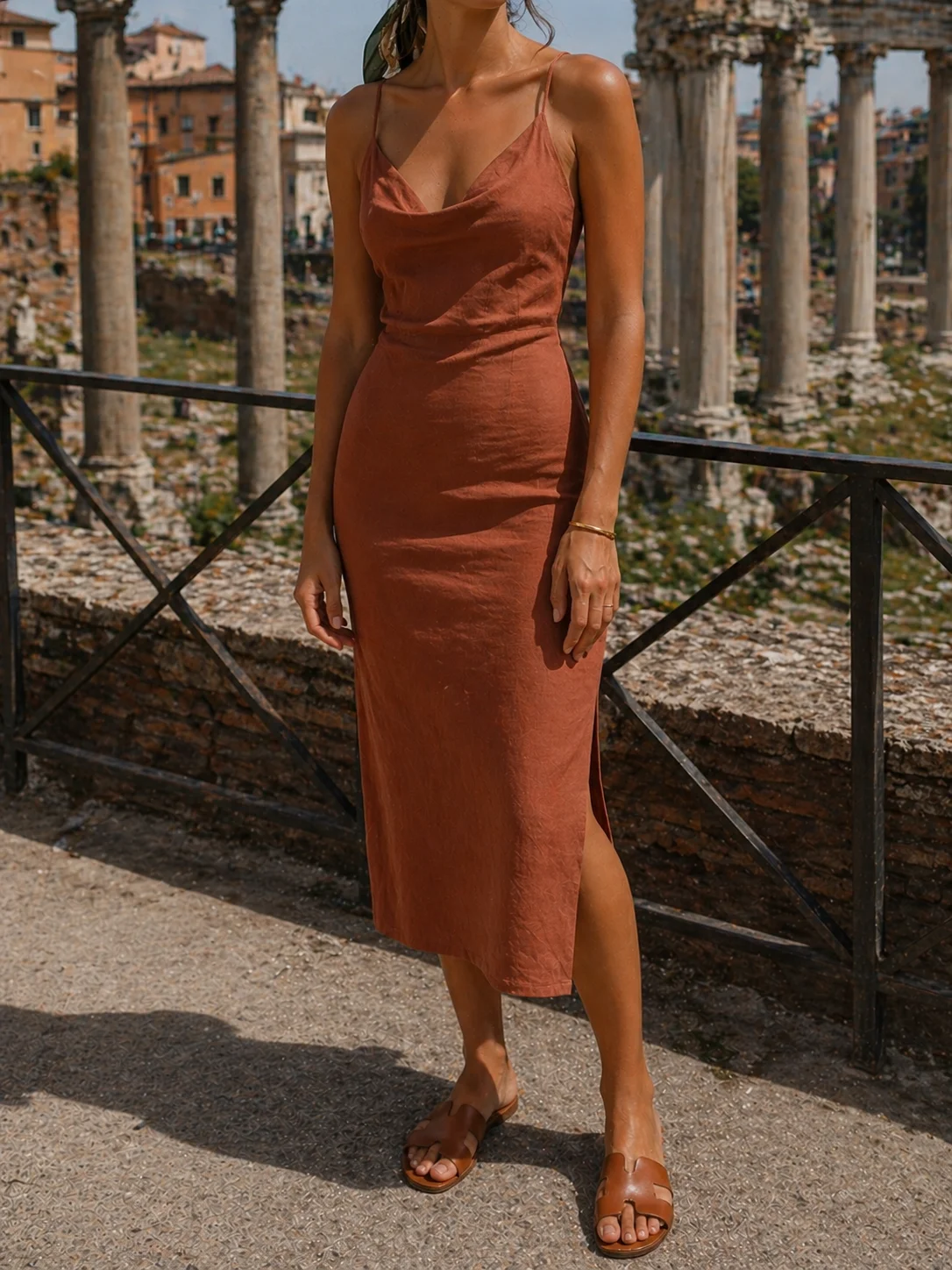
Blend In
A deep terracotta shade mimics the shadows on historic buildings for a grounded, monochromatic look.
Wardrobe Breakdown
What to wear in Rome in August?
Fabrics
The Best Fabrics for Rome's August Heat and Marble Glare
Rome's August problem is not just heat; it is reflected heat. Standing in Piazza del Campidoglio or crossing the exposed stretch between the Colosseum and the Arch of Constantine feels hotter because pale stone and open ground throw light straight back at you. Locals who stay in the city lean into fabrics that move and breathe: linen shirts, cotton poplin dresses, airy sleeveless tops with a shirt carried over them, and loose trousers in light colors. Technical gym fabrics can trap odor after a long, sweaty day from the Forum to Trastevere, and clingy polyester photographs badly once the humidity rises after a storm. Do not bring heavy denim shorts as your main daytime option; they feel stiff and hot when you sit on sun-warmed stone or ride a packed bus. A loose cotton shirt that can go over a tank top earns its place twice, for sun protection in the afternoon and shoulder cover in basilicas like Santa Maria Maggiore. Build around natural fibers and save synthetics for one quick-dry backup piece at most.
Layers
The Best Layers for Rome's Churches, Museums, and Late Tiber Walks
In August, Rome teaches you that one extra layer can solve three separate problems in a single day. First there are church dress expectations at St Peter's Basilica, the Pantheon, and major basilicas where bare shoulders or very abbreviated outfits can create friction at the entrance. Then there is the sudden chill of air-conditioning inside museums, airport trains, and department stores like La Rinascente on Via del Tritone. Finally there are long evenings by the Tiber when the temperature stays warm but you still want a light cover against mosquitoes and river damp. Romans rarely tie a hoodie around the waist in summer; they carry a crisp shirt, a fine cotton cardigan, or a thin overshirt that looks intentional with the rest of the outfit. Do not pack a bulky sweatshirt that takes half your bag and feels wrong at dinner in Monti. Bring one elegant, featherweight layer that can step into a church, onto a terrace, or through an aggressively cooled gallery without making you look like you dressed for another season.
Footwear
The Best Footwear for Rome's Sampietrini, Steps, and August Pavements
Rome is hard on feet in ways that do not show up on a packing template. The city's beautiful paving includes uneven sampietrini cobbles, polished church thresholds, sloped lanes in Monti, and archaeological surfaces around the Forum that punish flimsy soles. In August, heat makes this worse: flat sandals without support start to feel brutal by the third church and the second gelato stop. Locals in the historic center often wear leather sandals with structure, sleek trainers, or loafers with real grip, not beach flip-flops. Do not bring brand-new fashion sandals for a city where you may walk from Termini to Santa Maria Maggiore, climb the Spanish Steps, and still end up crossing Trastevere after dinner. Equally, avoid heavy boots; they are absurd in Rome's August furnace. Your best bet is one pair of broken-in trainers with grip for long sightseeing days and one smarter sandal or loafer for evenings. Prioritize sole traction, cushioning, and straps or uppers that keep the shoe stable on stone.
The Edit
Rome Capsule Wardrobe
7 days, carry-on only. Built for Rome's heat-baked ruins, basilica visits, and long dinners after dark.

Carry-on only
Light enough for the Forum and Palatine when the stone starts radiating heat before lunch.
Shop tops →Your shoulder cover for St Peter's Basilica and your sun shield on exposed walks near the Colosseum.
Shop shirts →Easy for moving from Campo de' Fiori mornings to dinner in Monti without a full outfit change.
Shop dresses →Cooler than denim for long bus waits and fountain-to-fountain walks through Centro Storico.
Shop shorts →Better than shorts for basilicas, evening terraces, and air-conditioned museums on Via Nazionale.
Shop trousers →Useful on Leonardo Express air-con and late Tiber river walks during Estate Romana nights.
Shop layers →Your reliable pair for sampietrini cobbles, metro stairs, and the long lap from Trevi to Trastevere.
Shop trainers →Smarter than sneakers for dinners near Piazza Navona while still stable on uneven stone.
Shop sandals →The Core
Your Packing Checklist
0 of 26 items packed
0%
Outerwear
0/3- Featherweight overshirt for basilica entries and icy museum air-conditioning around Via del Corso.
- Packable layer for late Tiber walks when river mosquitoes come out after sunset.
- Tiny emergency umbrella for the short August thunderstorms that steam off Rome's stone streets.
Tops & Layers
0/4- Loose linen tops that stay wearable between the Colosseum, Forum, and long bus rides without clinging.
- One shoulder-covering shirt for St Peter's Basilica, Santa Maria Maggiore, and other church interiors.
- Breathable evening top that still looks polished in Monti or Trastevere after a sweaty sightseeing day.
- Quick-dry underwear because August heat in Rome makes midday refreshes more useful than extra outfits.
Bottoms
0/3- Airy trousers for church visits, dinners, and relief from sun exposure on open piazzas.
- Tailored shorts rather than heavy denim for long stretches on heat-holding sampietrini.
- Light midi skirt or dress option that works in both Vatican queues and evening aperitivo spots.
Footwear
0/3- Grip-sole trainers for Rome's polished church thresholds, metro stairs, and uneven cobbles.
- Structured sandals for evening meals near Piazza Navona without slipping on smooth paving.
- Blister plasters because a Rome day often turns into 20,000 steps before you notice.
Accessories
0/4- Wide-brim hat or cap for the exposed walkways around the Roman Forum and Palatine Hill.
- Sunglasses for the intense bounce of light off travertine facades and open piazzas.
- Crossbody bag with zip closure for crowded Metro A platforms and Trevi Fountain bottlenecks.
- Reusable water bottle for Rome's nasoni drinking fountains scattered across the historic center.
Toiletries & Health
0/4- High-SPF sunscreen because Rome's August sun reflects hard off pale stone and open archaeology sites.
- After-sun or light aloe gel for days spent between the Forum, Vatican, and riverside evenings.
- Electrolyte tablets for Ferragosto-week heat when many neighborhood shops close midday or for ferie.
- Mosquito repellent for Tiber-side events and open-air evenings during Estate Romana.
Documents & Tech
0/5- Passport with at least 3 months' validity beyond your Schengen departure date and issued within the last 10 years if you are a non-EU traveller.
- Visa paperwork only if your nationality requires it; many visitors from the UK, US, Canada, and Australia can enter Italy visa-free for up to 90 days in any 180-day Schengen period.
- Be ready for the EU Entry/Exit System biometric registration at the border in 2026 if you are a non-EU short-stay traveller; ETIAS is scheduled for later in 2026 and was not yet required at the time this guide was updated.
- Type C, F, and L plug adapter if you are not arriving with a continental European-compatible charger.
- ATAC Roma App or MooneyGo for buses, metro, and tickets, plus Free Now, itTaxi, or Uber for taxi booking in Rome.
Affiliate Picks
Shop the Essentials
Luggage Guide
What Luggage to Bring to Rome
Rome is rougher on luggage than it looks on a postcard. Between sampietrini cobbles, stair-heavy metro stations, and apartment buildings with tiny lifts or none at all, compact bags beat oversized cases fast.
3-5 days
🎒 Carry-on travel backpack
35–45 L / 9–12 gal
- ✓Easier on cobbles between Termini and old-center accommodation
- ✓Hands stay free on Metro A stairs and bus jumps
- ✓Fits Rome's short city-break rhythm
5-8 days
🧳 Compact spinner case
35–45 L / 9–12 gal
- ✓Works well if your hotel is near a taxi stand rather than a long cobbled lane
- ✓Keeps dressier evening pieces separate from dusty sightseeing shoes
- ✓Still manageable on Leonardo Express platforms
9+ days
🛄 Checked hold suitcase
70–90 L / 18–24 gal
- ✓Useful only if Rome is one stop in a longer Italy trip
- ✓Gives room for weddingwear or work gear
- ✓Better for airport-to-hotel taxi transfers than for old-center hauling
Plan Around Events
Events That Affect What You Pack
15 August 2026
Ferragosto
Carry extra water, snacks, and any medicines you need for the day because many neighborhood shops, pharmacies, and family-run restaurants close or shorten hours around Ferragosto.
1 July-31 August 2026
Estate Romana
Bring mosquito repellent and one polished light layer for Tiber-side screenings, concerts, and late outdoor events that start long after the hottest part of the day.
Before You Charge
Plug & Outlet type in Rome



🇺🇸 From the US?
You will need a plug adapter in Rome, and you must check voltage compatibility before plugging in anything that heats up. Most phone chargers, tablets, cameras, and laptops are dual-voltage and only need the adapter, but many US hair tools are not and can burn out without a converter.
🇬🇧 From the UK?
You will need an adapter because UK Type G plugs do not fit Italian sockets. Voltage is the same 230V/50Hz as the UK, so phone chargers and laptops usually work straight away with just an adapter; heated brushes and straighteners normally do too if they are UK-rated.
🇲🇹 From Malta or much of Europe?
Malta uses the same 230V/50Hz electricity, but Maltese Type G plugs still need an adapter in Italy. Travellers already using Type C or F plugs will often be able to charge phones and laptops directly, though Type L sockets still appear in many older buildings.
🇦🇺 From Australia?
You will need a plug adapter for Rome. Australian chargers for phones, cameras, and many laptops are commonly dual-voltage and should be fine with an adapter alone, but check hair dryers, curling tools, and older appliances carefully before using them on Italy's 230V supply.
Getting Around
How to Get Around Rome
Central Rome is compact enough to walk in chunks, but the city sprawls fast once you leave the historic core. Most visitors end up combining walking with ATAC buses or metro, then using a train for the airport and taxis at the hottest or latest hours.
Walking
Rome rewards walking between major sights because the historic center folds one piazza into the next, but distances are longer than they look on a map. Start early because the route from Trevi to the Colosseum feels very different at 8am than at 2pm on heat-radiating stone.
No app needed
ATAC Metro, Bus, and Tram
ATAC runs Rome's metro, buses, trams, and urban rail tickets. Contactless tap&go works on metro gates and many surface services, and the official ATAC Roma App plus MooneyGo are practical for route checks and ticketing when queues at machines build up.
Visit site →Leonardo Express and FL1
For Fiumicino Airport, Leonardo Express is the simplest airport transfer because it runs non-stop to Roma Termini in about 32 minutes. FL1 is useful if you are staying in districts such as Trastevere, Ostiense, or Tiburtina rather than right by Termini.
Visit site →Free Now, itTaxi, and Uber
In Rome, taxi-booking apps are often easier than street hailing when the heat is punishing or a transport strike is looming. Free Now and itTaxi are widely used for licensed taxis, while the Uber app works in Rome for Taxi bookings and premium Black rides rather than as a cheap UberX-style default.
Visit site →In Case You Forgot Something
Where to Buy What You Forgot
La Rinascente Roma Tritone
Department StoreUseful for replacing forgotten summer clothing, sunglasses, beauty essentials, toiletries, and a better dinner outfit without crossing the city. The basement food hall is also handy when Ferragosto closures leave neighborhood options thin.
📍 Via del Tritone 61, 00187 Rome
🕐 Sun-Thu 10:00-21:00; Fri-Sat 10:00-22:00
ZARA Roma Bocconi - Verospi
Fast FashionGood for a last-minute linen shirt, covered-shoulder top, airy dress, or smarter evening sandals after you realize beachwear is not cutting it inside Rome's churches and restaurants.
📍 Via del Corso 189, 00186 Rome
🕐 Typically daily until 21:00; check same-day hours before going in August
Pam Local Roma S.M. della Battaglia
SupermarketReliable for water multipacks, fruit, pharmacy basics, snacks for long museum queues, and picnic supplies near Termini. It is especially useful on Sundays when smaller independent groceries may have shorter hours.
📍 Via San Martino della Battaglia 30, 00185 Rome
🕐 Mon-Sat 08:00-22:00; Sun 09:00-22:00
Farmacia Termini
FarmaciaBest for blister plasters, sunscreen, electrolytes, basic medication, and travel-health emergencies right inside the station. Handy if you arrive from the airport and already know you forgot something important.
📍 Stazione Termini, Via Marsala 29, 00185 Rome
🕐 Daily 07:00-21:00
Decathlon Roma Appio
Sporting GoodsStrong option for emergency trainers, water bottles, anti-blister gear, swimwear for a beach day, and lightweight backpacks if your footwear plan for Rome's cobbles fails on day one.
📍 Via Appia Nuova 450, Metro Furio Camillo, 00181 Rome
🕐 Daily 10:00-20:30
Apple Via del Corso
ElectronicsUseful for replacement charging cables, plugs, adapters, and battery problems when your phone is doing heavy duty with maps, tickets, and photos all day in the Roman heat.
📍 Via del Corso 181-188, 00186 Rome
🕐 Daily 09:30-20:30
Free download
Rome packing checklist
Get a printable checklist for Rome, plus bonus reminders for basilica dress rules, Ferragosto closures, plug adapters, and nasoni water-fountain essentials.
No spam, ever.
🇮🇹 More from Italy
Also in Italy
See the full What to wear in Italy style guides by city and month.
What to wear in Amalfi Coast in August
Italy packing guide
What to wear in Cinque Terre in July
Italy packing guide
What to wear in Florence in June
Italy packing guide
What to wear in Milan in May
Italy packing guide
What to wear in Naples in May
Italy packing guide
What to wear in Rome in May
Italy packing guide
What to wear in Sicily in June
Italy packing guide
What to wear in Venice in July
Italy packing guide
What to wear in Venice in May
Italy packing guide
Same Time of Year
Other European cities to visit in August
A diverse pick across countries — packing for August weather, with city-specific color palettes and capsule wardrobes for each.
What to pack for Brussels in August
Belgium
What to pack for Costa del Sol in August
Spain
What to pack for Iceland in August
Iceland
What to pack for Interlaken in August
Switzerland
What to pack for Mykonos in August
Greece
What to pack for Saranda in August
Albania
What to pack for Algarve in August
Portugal
What to pack for Ibiza in August
Spain