What to Pack for Ireland in July (2026): Outfit tips for emerald pasture & misty-cliff backdrops
July · 12–19°C (54–66°F) · Waterproof layers, grip shoes, and warm extras for Atlantic coast walks, pub nights, ferry breezes, and green-road trips
Start Here
Table of Contents
Setting the Scene
What to Expect in Ireland in July
Ireland in July smells of wet grass, turf smoke where people still light fires on cooler days, sea salt on the west coast, and chips steaming out of paper near harbours and market towns. You hear gulls over Galway docks, trad music leaking out of pub doorways before dark, tyres hissing on wet country roads, and sheep somewhere you still cannot see when the road narrows in Connemara or Kerry. The light is the thing people underestimate. It hangs around late over stone walls, bog, and headlands, and even on cloudy evenings there is a silvery glow that keeps the landscape looking awake. Locals do not dress like it is guaranteed summer. In towns from Westport to Kinsale, people wear waterproofs, light knits, fleeces, trainers, and jeans because a pub garden in sunshine and a cliff walk in wind are still two different climates in the same day.
July is when Ireland feels fully open without becoming uniform. The Ring of Kerry is busy, Galway streets are lively, and ferries to the Aran Islands, Achill detours, and coastal drives all feel possible, but the country still behaves according to weather more than according to calendar. A morning that starts bright in Dublin can turn cooler by the time you reach the Wicklow Mountains, and a sunny harbour lunch in Dingle can become a windswept cliff stop an hour later. That is why what locals wear is such a useful clue: one layer for the road, one layer for the coast, and shoes that can handle a village main street, a damp field entrance, and a viewpoint car park without complaint. Ireland in July is less about heat than about range. The country rewards anyone who packs for Atlantic wind, soft rain, grassy ground, and evenings that last far longer than the temperature does.
Pub Spill
Trad music leaks to streets
Cliff Wind
Atlantic gusts cut through sunshine
Road Pause
Sheep stop narrow drives
Late Glow
Hedgerows stay bright past ten
Ireland weather in July
Average Temperature
July
19°C / 66°F
12°C / 54°F low
Mild, bright, changeable
9 days
West coast turns wetter faster
6.8 hrs
Long evenings after coastal drives
80%
Atlantic damp lingers after rain
18 kmh / 11 mph
Headlands and ferry decks feel cooler
Local Style
What does Ireland in July feel like?
🧥
Ireland in July is green, bright, and genuinely pleasant, but it is rarely the sort of summer where you can forget about weather and just live in shorts. If you are arriving from southern Europe, the Atlantic breeze on the Cliffs of Moher, Inis Mór ferries, or the Dingle coast will feel much cooler than the 19°C (66°F) headline, while if you are coming from Britain the extra daylight can make the country feel more summery even though the rain still turns up without much warning.
Style Palette
Colors of Ireland
The deep, rain-fed intensity of the pastures in the Ring of Kerry that remains shockingly vivid even in the July heat.
Blend into the landscape for a lush, monochromatic look that makes you feel like a local wood-nymph.
This forest green is a total powerhouse for redheads and those with warm or olive undertones.
The sheer, vertical grey limestone faces and the misty, salt-sprayed air of the Wild Atlantic Way.
It provides a grounding, sophisticated contrast against the overwhelming greenery of the countryside.
This cool, stony grey is a dream for neutral to cool undertones, feeling polished and urban.
The bright, coconut-scented yellow wildflowers that line the narrow boreens and coastal paths all summer.
Pop hard—this yellow vibrates beautifully against the green hills and looks electric in the soft, diffused Irish light.
Warm and golden skin tones will absolutely glow when paired with this punchy, sunny shade.
The muted, dusty purple bells that begin to carpet the rocky karst landscapes of County Clare in July.
Avoid wearing this if you're hiking the Burren, but it's a romantic 'blend' choice for a cozy pub evening.
This desaturated lilac is exceptionally flattering on fair, cool complexions.
Signature Outfit
An Emerald Atlantic linen midi skirt paired with a Cliffs of Moer Slate lightweight knit. Tie a Gorse Bloom yellow scarf around your neck. It’s a look that’s prepared for the inevitable 'four seasons in one day' while echoing the island's wild, saturated palette.
Blend In Like a Local
How to Dress in Ireland Without Looking Like a Tourist
Ditch the neon oranges and clinical stark whites. Neon feels jarringly artificial against the ancient, organic landscape. Stark white can also look a bit too 'Mediterranean cruise' for the rugged, breezy Irish coast—stick to creams or oatmeal tones instead.
Top 3 Outfit Colors to look perfect in every Photo
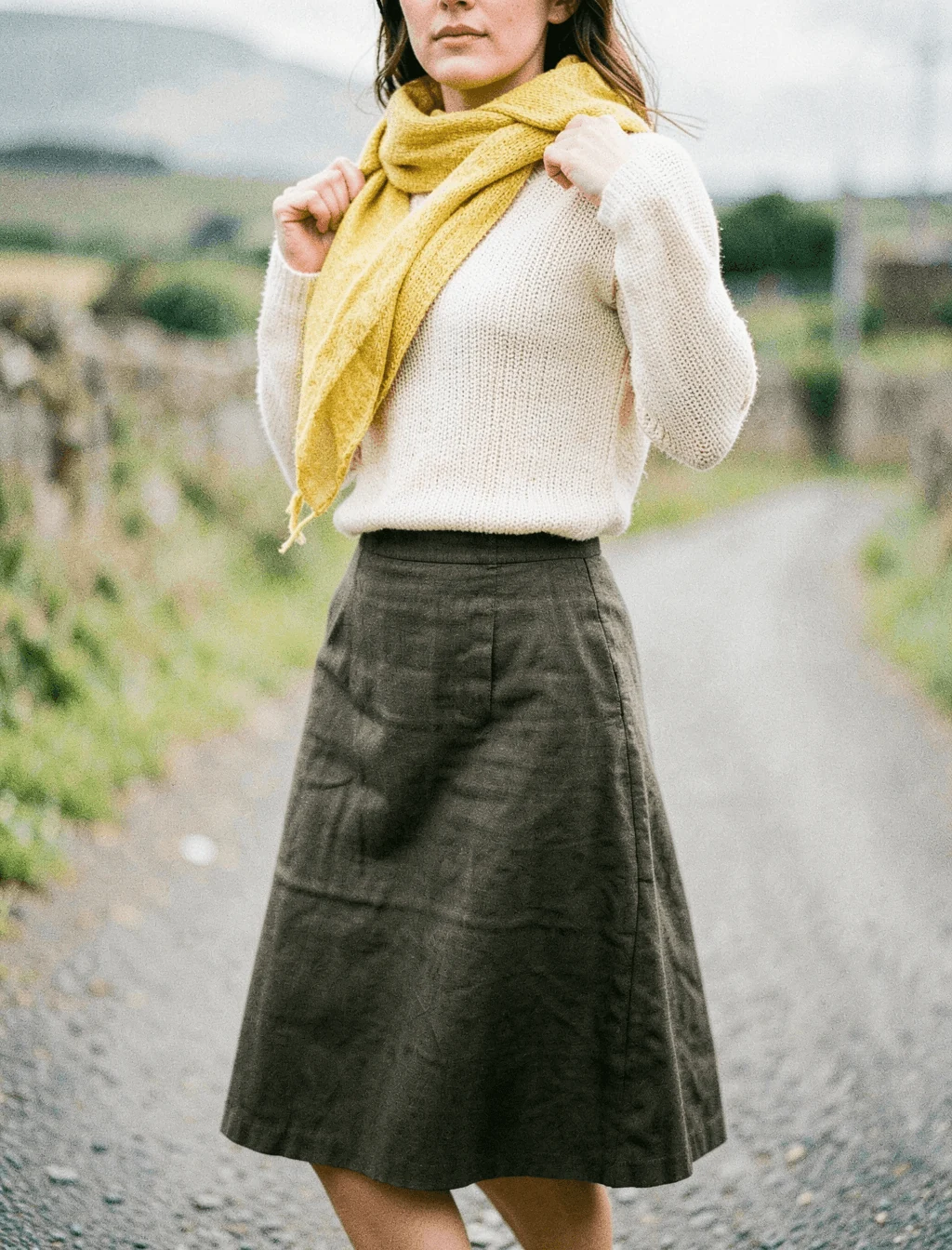
Blend In
Go for a deep hunter green to match the shaded glen forests for a grounded, heritage aesthetic.
Wardrobe Breakdown
What to wear in Ireland in July?
Outerwear
The Best Light Jackets for Ireland in July
The biggest Irish packing mistake is taking the word summer too literally. July can absolutely deliver warm bright afternoons in Killarney, Galway, or the Wicklow coast, but the Atlantic still runs the show and a dry morning can turn drizzly by lunch. Locals solve this with light waterproofs, waxed jackets, fleeces, and overshirts rather than one heavy coat or no jacket at all. You see people carrying a rain shell even on apparently perfect days because they know a harbour wind or a cliff-top stop can change the feel of the day in minutes. Do not bring a bulky winter coat, but do not rely on a denim jacket with no rain protection either. Pack one real light waterproof and one warm mid-layer.
Layers
The Best Knits and Mid-Layers for Ireland's Long July Days
What really works in Ireland in July is not more summer tops but better layers. The days are long and the scenery encourages you to stay out, but once the sun slips or the wind turns seaward the temperature drops quickly, especially on islands, headlands, and pub gardens after dark. Locals rely on fleeces, merino knits, cotton crewnecks, and overshirts that can move from road trip to harbour walk to late music session without a full outfit change. A fleece stuffed in the car or daypack is practically a local reflex. Do not pack only T-shirts because the forecast says 19°C (66°F). Bring two or three useful mid-layers, and make at least one of them something you would happily wear in a pub in Galway or Kinsale after a coastal drive.
Footwear
The Best Shoes for Ireland's Harbour Towns, Fields, and Coastal Paths
Footwear matters in Ireland because even relaxed itineraries mix town paving, muddy verges, gravel viewpoints, wet grass, and slippery harbour edges. A day that starts with coffee in Galway or Dingle can easily include a lighthouse walk, a castle garden, or a cliff stop where the ground is softer than it looks. Locals usually wear trainers, trail shoes, low boots, and sturdy loafers with real grip rather than anything flimsy. You rarely see sensible people attempt the west coast in smooth-soled sandals after rain. Do not bring fashion flats as your main pair if you plan to drive the Wild Atlantic Way, and do not assume white canvas trainers will survive happily. Pack one pair with tread and water tolerance, then add a second easier shoe for dinners and city stops.
The Edit
Ireland Capsule Wardrobe
7 days, carry-on only. Built for Ireland's Atlantic coast, pub evenings, road-trip stops, ferry crossings, and rain-prone countryside detours.

Carry-on only
Your weather shield for the Cliffs of Moher, Dingle headlands, ferry decks, and those showers that arrive halfway through a viewpoint stop.
Shop jackets →The extra warmth piece for late pub gardens, coastal drives, and island crossings where July still feels brisk.
Shop knits →Useful for castle visits, city stops in Dublin or Galway, and easier layering when the weather flips mid-route.
Shop shirts →Enough for brighter afternoons on country drives and easier town days without overpacking for warmth alone.
Shop tops →Better than flimsy summer bottoms on wet grass pull-ins, harbour edges, and rain-damp pub benches.
Shop trousers →Your main pair for village streets, boggy car parks, and cliff-path approaches from Clare to Donegal.
Shop shoes →The daypack handles layers, the cap helps on bright coast roads, and the scarf earns its place whenever the Atlantic wind turns colder than expected.
Shop packs →The Core
Your Packing Checklist
0 of 28 items packed
0%
Outerwear
0/4- Light waterproof jacket for Atlantic showers on the Wild Atlantic Way and city drizzle in Dublin or Galway.
- Packable warm layer for cliff-top wind at Moher, Achill, Slea Head, or Malin Head.
- Compact rain cover for road trips where the next dry stop may be farther away than the map suggests.
- Thin scarf for ferries to the Aran Islands or late pub-garden sessions after the temperature drops.
Tops & Layers
0/4- Merino or fleece mid-layer for breezy headlands, damp castle grounds, and long evening light that outlasts the warmth.
- Long-sleeve shirts for city days in Dublin, Cork, or Galway that still need one eye on the rain.
- Quick-dry tops for road-and-walk days when rain and sunshine can swap places within an hour.
- One smarter layer for nicer pub dinners or music nights in Kinsale, Westport, or Galway.
Bottoms
0/3- Quick-dry trousers or sturdy jeans for wet verges, harbour seating, and soft ground at coastal viewpoints.
- One lighter trouser for sunnier inland stretches and city breaks between rural legs.
- Skip flimsy linen shorts as your main sightseeing bottom; Ireland's wind and damp grass make them less useful than they look.
Footwear
0/4- Water-tolerant walking shoes for coastal paths, ferry ramps, and rain-darkened paving in old market towns.
- Grip-sole trainers for Irish road-trip stops where a car park often turns into a muddy viewpoint path.
- Warm socks for long driving days with repeated outdoor stops from Wicklow to Kerry.
- Do not rely on smooth-soled city shoes if you plan cliffs, islands, or grassy castle grounds.
Accessories
0/4- Sunglasses for bright late-day glare off the Atlantic and lakes in Connemara, Clare, or Kerry.
- Cap for long July daylight on coastal drives and open ferry decks.
- Crossbody or day bag for city days, pub stops, and ferry boarding without juggling a jacket in your hands.
- Reusable water bottle for cliff walks, long drives, and village stretches where shops are not always right there.
Toiletries & Health
0/4- SPF 30+ for long July daylight and strong reflected light on water even when the air feels mild.
- Blister plasters for cliff approaches, harbour towns, and the extra walking Irish itineraries quietly add.
- Motion-sickness tablets if you plan Aran Islands, Skellig trips, or other Atlantic ferry crossings.
- Prescription medicines plus a copy of the prescription for an Irish pharmacy if you need a refill.
Documents & Tech
0/5- Type G plug adapter for Ireland's 230V, 50Hz sockets if you are arriving with EU, US, or Australian plugs.
- Passport and entry paperwork: many visitors from the EU, USA, Canada, Australia, New Zealand, and other non-visa nationalities can enter Ireland without a visa for short tourist stays in 2026, but the Republic of Ireland is outside the Schengen Area so do not assume Schengen rules cover this trip.
- Passport validity check for Ireland in 2026: your passport should be valid for the whole of your stay; Ireland does not use the Schengen-style extra 3-month validity rule.
- ETIAS and EES note for 2026: neither applies to Ireland because the Republic of Ireland is outside the Schengen Area, so Schengen border systems are not the entry rule that matters here.
- Install the Transport for Ireland journey planner, the Irish Rail app, and FREE NOW for taxis in Dublin and other cities, while Uber in Ireland works through licensed drivers rather than a broad private-car model.
Affiliate Picks
Shop the Essentials
Luggage Guide
What Luggage to Bring to Ireland
Ireland is easier on luggage than Venice or Santorini, but the trip often mixes airport transfers, rail platforms, village guesthouses, ferry ramps, and wet roadside stops in the same week. Compact luggage is still much easier than a giant case when the plan includes both cities and coast.
Weekend trip
🎒 Structured travel backpack
25–30 L / 7–8 gal
- ✓Best for ferry ramps, station changes, and small guesthouses
- ✓Hands-free on rural bus stops and cliff-path detours
- ✓Simpler than wheels if your trip is more towns and islands than one hotel base
Road trip
🧳 Small carry-on spinner
35–45 L / 9–12 gal
- ✓Most practical for 4 to 7 nights around Ireland in mixed July weather
- ✓Room for a rain shell, fleece, and a second pair of shoes without overpacking
- ✓Still manageable in trains, hire cars, and B&B staircases
Longer loop
🛄 Medium check-in suitcase
60–70 L / 16–18 gal
- ✓Useful if Ireland is part of a longer UK or Europe trip
- ✓Leaves room for extra weather layers and shopping from Dublin or Galway
- ✓Still easier than an oversized case in B&Bs and small-town hotels
Plan Around Events
Events That Affect What You Pack
3–5 July 2026
Kaleidoscope Festival
A family festival at Russborough means grass underfoot, open-air stages, and Irish weather all in one weekend, so bring a proper waterproof and shoes you do not mind getting muddy rather than dressing only for sunshine.
13–26 July 2026
Galway International Arts Festival
Galway festival days mean long hours outdoors between venues and a lot of standing in sea-influenced evening weather, so bring a warmer layer than a pure city-break forecast suggests.
27 July – 2 August 2026
Galway Races Summer Festival
The racecourse is more exposed than central Galway, so pack one smarter waterproof layer and shoes that handle grass, rain-softened ground, and long standing hours better than delicate city footwear.
Before You Charge
Plug & Outlet type in Ireland

🇺🇸 From the US?
You need a Type G adapter in Ireland, and older US hair tools may also need a voltage converter because Ireland uses 230V. Phone chargers, laptops, and camera chargers are usually dual-voltage if the plug brick says 100-240V.
🇬🇧 From the UK?
You do not need an adapter in Ireland because the Republic uses the same Type G plug and 230V system as the UK. This is one of the easiest categories to ignore when packing.
🇩🇪 From Germany or much of continental Europe?
You need a Type G adapter because standard EU plugs do not fit Irish sockets, even though the voltage is the same 230V. Most chargers will work perfectly once adapted.
🇦🇺 From Australia?
You need an adapter because Australian plugs do not fit Irish sockets, but the voltage is the same 230V. Most chargers work normally once adapted, though straighteners and similar appliances still need a quick label check.
Getting Around
How to Get Around Ireland
Ireland is compact enough for road trips but spread out enough that you cannot think of it as one walkable destination. City breaks, coastal drives, island ferries, and small-town stays all use different transport patterns, so the country works best when you combine walking with trains, buses, and occasional taxis or a rental car.
Walking
Dublin, Galway, Cork, Kilkenny, and many smaller towns are easy to explore on foot, but countryside viewpoints, island stops, and national-park detours almost always need transport between walks.
No app needed
Transport for Ireland
Transport for Ireland is the core national planner for bus, rail, tram, Local Link, taxi, and bicycle routing, and it is the best place to understand how Irish public transport actually joins up.
Visit site →Iarnród Éireann / Irish Rail
Irish Rail is the backbone for intercity travel between Dublin, Cork, Galway, Limerick, Sligo, and other major gateways before you switch to local buses or a hire car.
Visit site →TFI bikes and city bike schemes
Bike sharing is mainly useful in larger cities such as Dublin, Cork, and Limerick rather than across the country, but it works well for flatter urban stretches and riverside routes.
Visit site →Island and coastal ferries
Ferries matter on Irish trips for the Aran Islands, Clare Island, Inisbofin, and some peninsulas, and the deck wind regularly feels colder than the harbour forecast.
Visit site →FREE NOW and Uber
FREE NOW is the strongest taxi app in Dublin and other Irish cities, while Uber in Ireland works through licensed drivers rather than a wide private-car system, so coverage depends more on local taxi supply than on app branding.
Visit site →Rental car
A rental car makes the biggest difference on Ireland trips if you plan the Wild Atlantic Way, Wicklow, Kerry, Mayo, or smaller villages beyond the main rail lines.
No app needed
In Case You Forgot Something
Where to Buy What You Forgot
Stephen's Green Shopping Centre
Shopping CentreThe easiest one-stop central-Dublin rescue for clothing, toiletries, accessories, food, and practical purchases before you head onward around Ireland.
📍 St Stephen's Green, Dublin 2, D02 HX65
🕐 Mon-Wed, Fri-Sat 08:30-19:00; Thu 08:30-20:00; Sun 11:00-18:00
Zara Dublin Gaiety
Fast FashionUseful for light rain layers, trousers, knitwear, and polished basics that fit Irish towns and city evenings better than pure outdoor gear.
📍 40-43 South King Street, Dublin 2, D02 EC93
🕐 Hours vary by season and day; check the store locator before going
Dunnes Stores Stephen's Green
SupermarketA practical city-centre stop for groceries, snacks, bottled water, picnic basics, and everyday clothing essentials under one roof.
📍 10-11 St Stephen's Green, Dublin 2, D02 RD40
🕐 Mon-Fri 08:30-20:00; Sat 08:30-19:00; Sun 11:00-19:00
Boots Dublin Grafton Street
PharmacyThe most useful central pharmacy-style stop for sunscreen, blister plasters, pain relief, cosmetics, and travel health basics.
📍 12 Grafton Street, Dublin, D02 HK49
🕐 Mon-Wed 08:00-19:30; Thu 08:00-20:00; Fri 08:00-19:30; Sat 08:30-19:00; Sun 11:00-19:00
Mountain Warehouse Dublin - O'Connell Street
Outdoor GearBest for waterproofs, walking socks, fleeces, daypacks, and practical kit if your Irish itinerary turns wetter or more outdoorsy than planned.
📍 30-31 O'Connell Street, Dublin, D01 DH58
🕐 Mon-Sat 09:30-18:00; Sun 12:00-18:00
Penneys Mary Street
Budget FashionHandy for low-cost socks, tees, rain extras, and quick replacements if a wet day or muddy walk ruins part of your suitcase plan.
📍 47-53 Mary Street, Dublin 1, D01 NX46
🕐 Hours vary by day and season; check locally before going
Free download
Ireland packing checklist
Get your Ireland printable checklist plus a bonus route guide with pub-town picks, scenic stop ideas, and smart ferry-and-road-trip planning tips.
No spam, ever.
Same Time of Year
Other European cities to visit in July
A diverse pick across countries — packing for July weather, with city-specific color palettes and capsule wardrobes for each.
What to pack for Antalya in July
Turkey
What to pack for Berlin in July
Germany
What to pack for Bruges in July
Belgium
What to pack for Bulgaria in July
Bulgaria
What to pack for Cinque Terre in July
Italy
What to pack for Copenhagen in July
Denmark
What to pack for Fjords in Norway in July
Norway
What to pack for Lake Bled in July
Slovenia